Explore our high-performance components, manufactured under rigorous quality benchmarks for worldwide deployment.
Analyzing procurement requirements, global compliance parameters, and critical industry applications for high-density networks.
Established in 2012 in Hong Kong as a high-tech communication enterprise, Kocent Optec Limited has emerged as one of China's leading fiber optic termination product manufacturers and solution providers. We are dedicated to developing and manufacturing fiber optic communication products ranging from passive to active categories for telecommunication networks, enterprise networks, and data centers.
By leveraging our extensive experience and excellent production capacity gained over the years, we magnify outcomes for our valuable customers, which ultimately expands their core competencies and helps them outperform competitors. We place emphasis on customer collaboration, and we define ourselves as your valuable partner in fiber optic connection solutions. We believe our differentiators are your perceived advantages.

In the modern telecommunications landscape, the 2 Core Fiber Optic Cable serves as a foundational component for duplex data transmission. Whether utilized in FTTH (Fiber to the Home) drops, industrial automation, or 5G fronthaul installations, the two-fiber structure provides dedicated transmit (TX) and receive (RX) channels, eliminating bandwidth bottlenecks and crosstalk associated with single-fiber bidirectional channels.
Enterprise procurement teams from telcos, ISPs, and real estate developers require rugged, lightweight, and bend-insensitive fiber systems. In FTTH environments, 2-core drop cables are favored because they allow operators to lease one fiber to a third party or retain the second fiber for future premium redundancy upgrades, effectively future-proofing the optical drop topology.
A deep dive into structural layouts, attenuation factors, and structural reinforcement mechanisms of 2-Core optical links.
Utilizing premium G657A1 and G657A2 single-mode optical fiber cores to minimize macro-bend loss under tight radius routing scenarios (down to 7.5mm).
Deploying non-conductive Fiber Reinforced Plastic (FRP) or heavy-duty steel wire strength members to prevent electromagnetic interference in industrial corridors.
Protected by Low Smoke Zero Halogen (LSZH) outer jackets, mitigating toxic gas release during combustion in high-density indoor/plenum applications.
| Parameters | Unit | FRP Strength Member Version | Steel Strength Member Version |
|---|---|---|---|
| Fiber Type Support | - | G.652D / G.657A1 / G.657A2 | G.652D / G.657A1 / G.657A2 |
| Attenuation (1310nm) | dB/km | ≤ 0.35 | ≤ 0.35 |
| Attenuation (1550nm) | dB/km | ≤ 0.21 | ≤ 0.21 |
| Short-term Tensile Strength | N | 200 | 600 |
| Long-term Tensile Strength | N | 100 | 300 |
| Crush Resistance (Short-term) | N/100mm | 1000 | 2200 |
| Operating Temperature Range | °C | -40 to +70 | -40 to +75 |
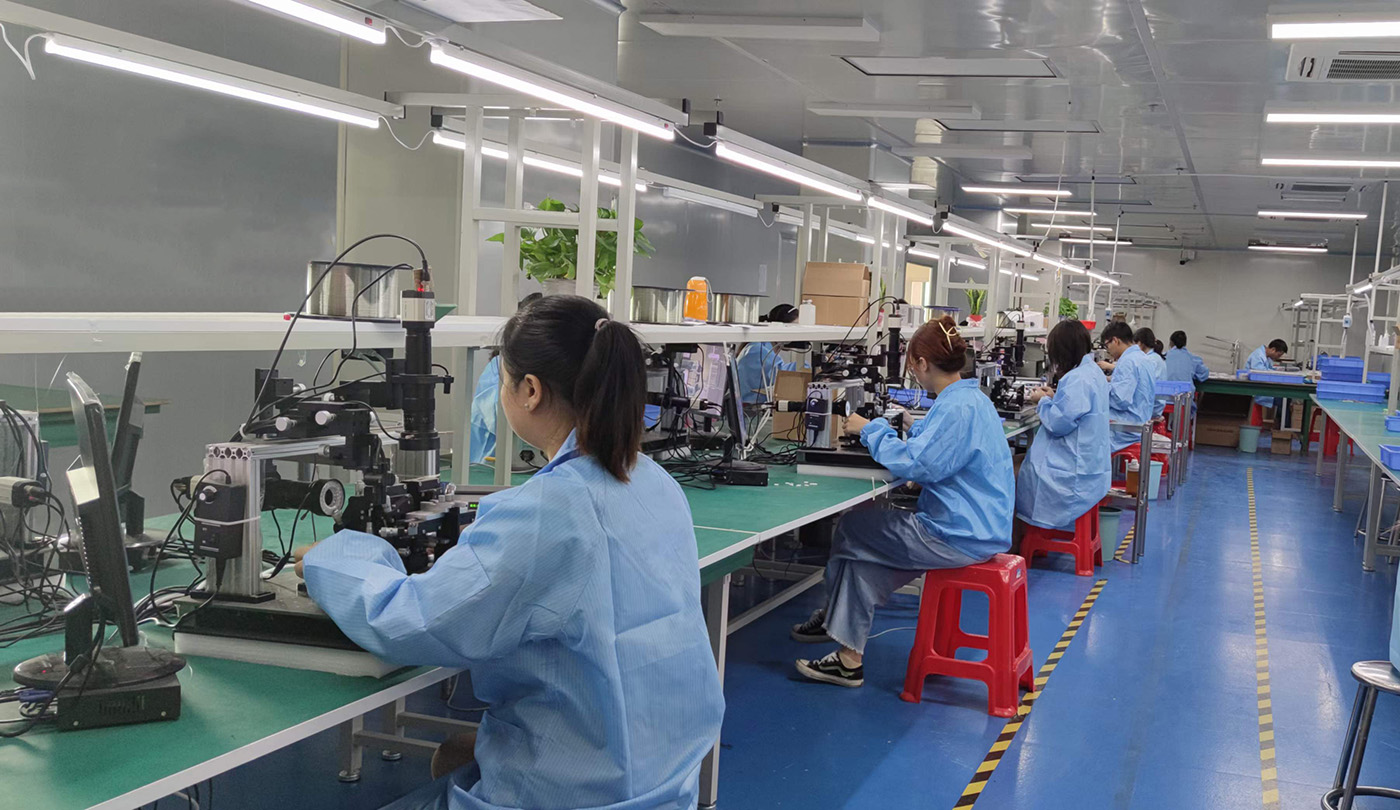
With more than 13 years of experience in manufacturing telecommunication fiber optic products, we strictly follow fiber optic industry standards by using mature scientific methods to deliver your products on time and ensure that 100% of products are tested and inspected before shipment.
Our core quality testing workflow encompasses geometry inspection, interferometry measurements, insertion loss (IL) diagnostics, and high-resolution optical time-domain reflectometer (OTDR) analyses. We enforce strict compliance protocols, aligning every production run with IEC, ISO9001, and Telcordia specifications.
Win-win cooperation is our constant goal. Many of our OEM and ODM products have won Telecom Operator tenders and satisfy strict end-user requests worldwide.
Years of sales and service experience have enabled us to win customers from different regions. Today, we have customers from East Asia, Southeast Asia, Middle East, Eastern Europe, Western Europe, Northern Europe, South America, North America, North Africa, and South Africa.
Anticipating the demands of Next-Generation Edge Networks, FTTR, and Hyper-Scale Optical Topologies.
As residential bandwidth applications transition to multi-gigabit speeds, 2-core transparent or ultra-thin drop cables are increasingly routed directly to localized desktop terminals or wireless nodes, bypassing legacy copper LAN infrastructure.
Emerging research outlines the inclusion of graphene or reinforced nano-particles in the polymer sheathing. This increases structural durability, tensile tolerance, and environmental resistance against rodent incursions without adding bulkiness.
Future optical networks will leverage distributed acoustic sensing (DAS) technologies. By utilizing the secondary core of a 2-core distribution run, operations divisions can detect localized line strain, mechanical cuts, or temperature spikes in real time.
Essential guidance for optical infrastructure engineering and procurement professionals.
Explore our complete product lineup, designed for seamless integration into enterprise backbones and hyperscale datacenters.
 KOCENT OPTEC