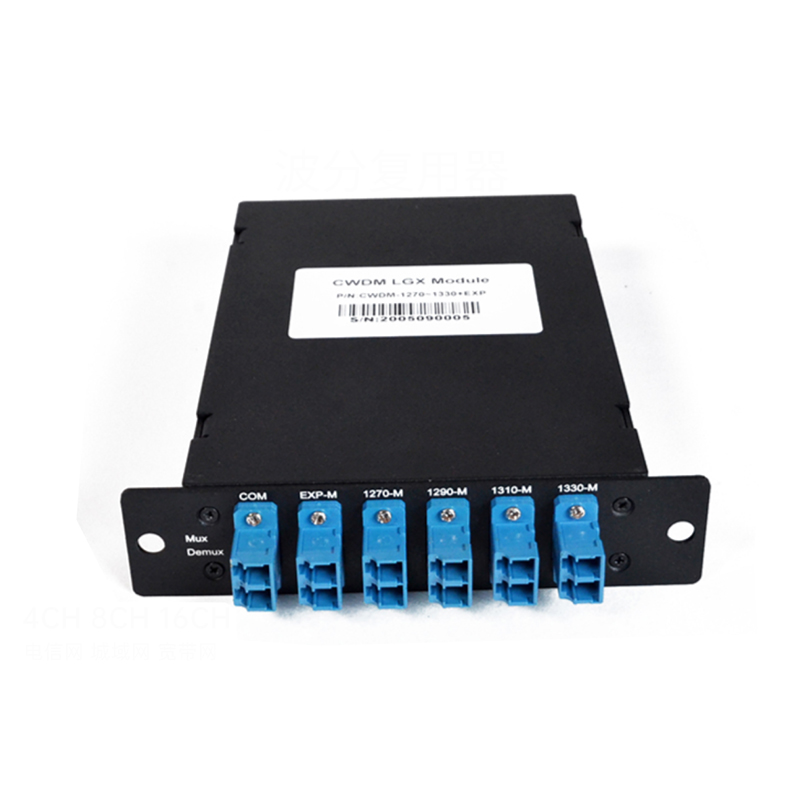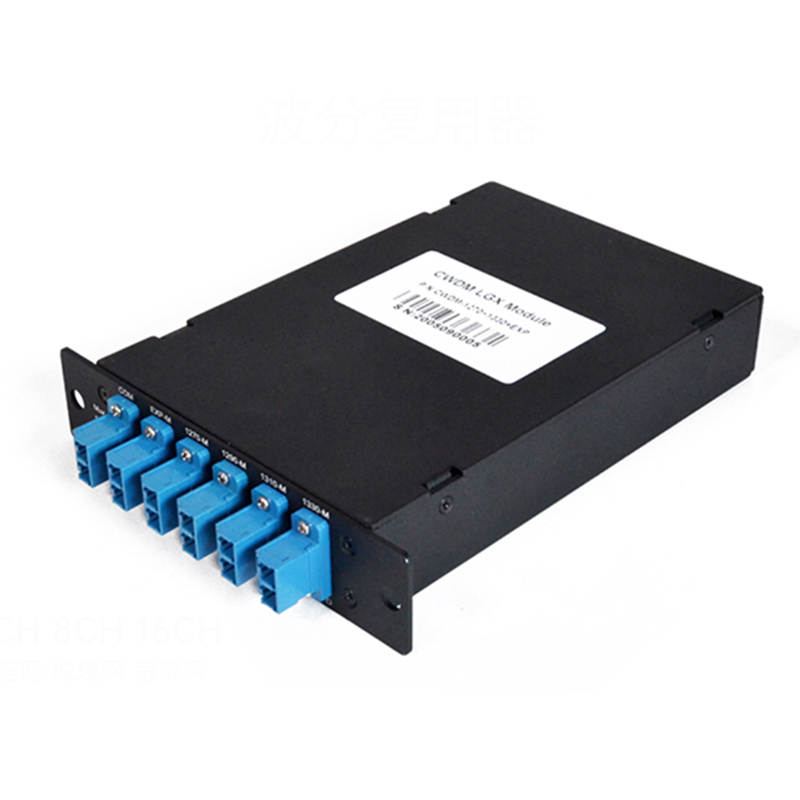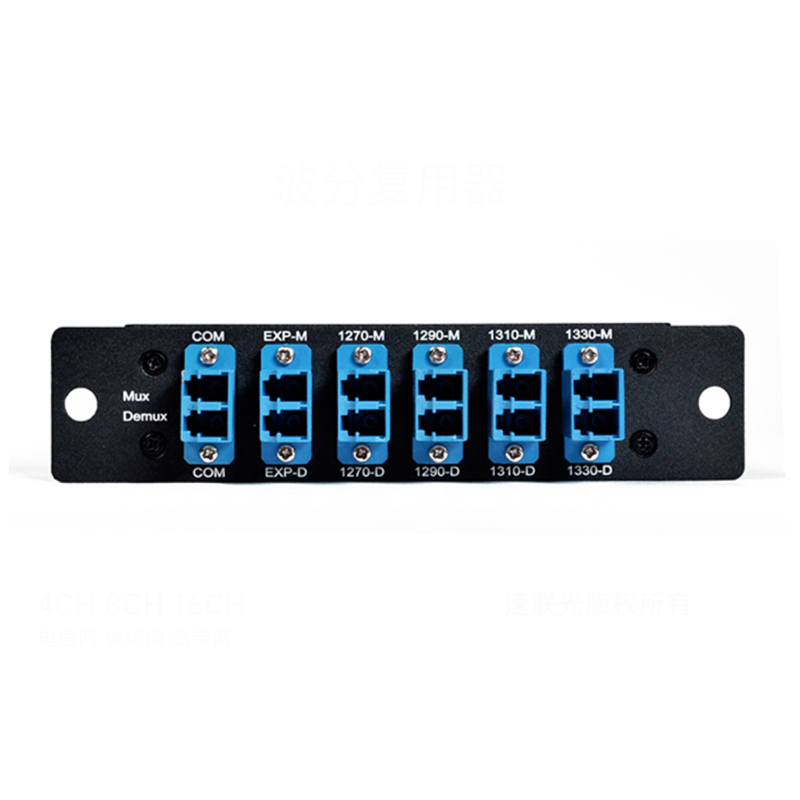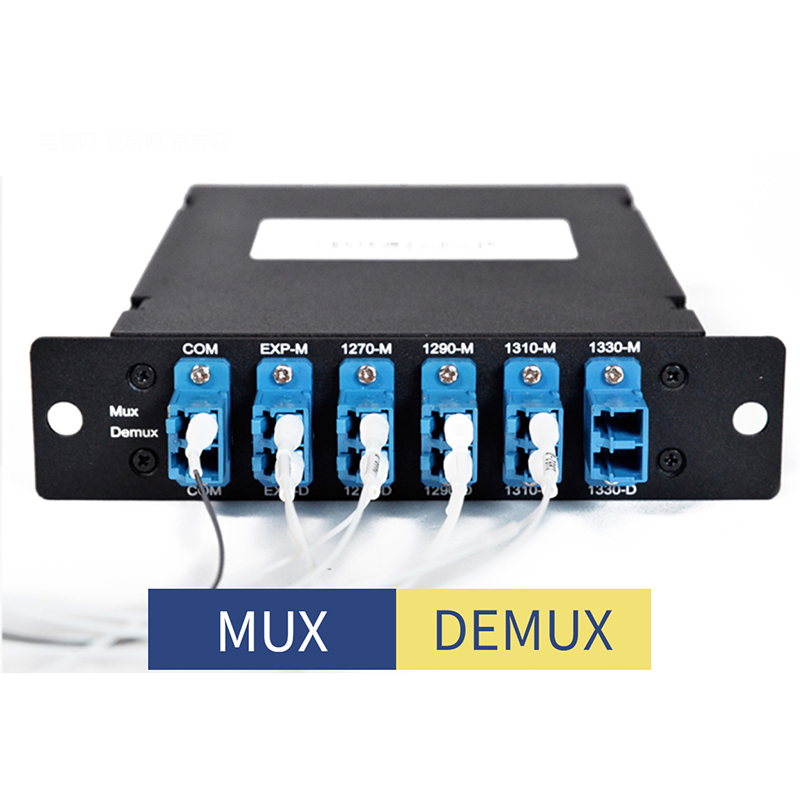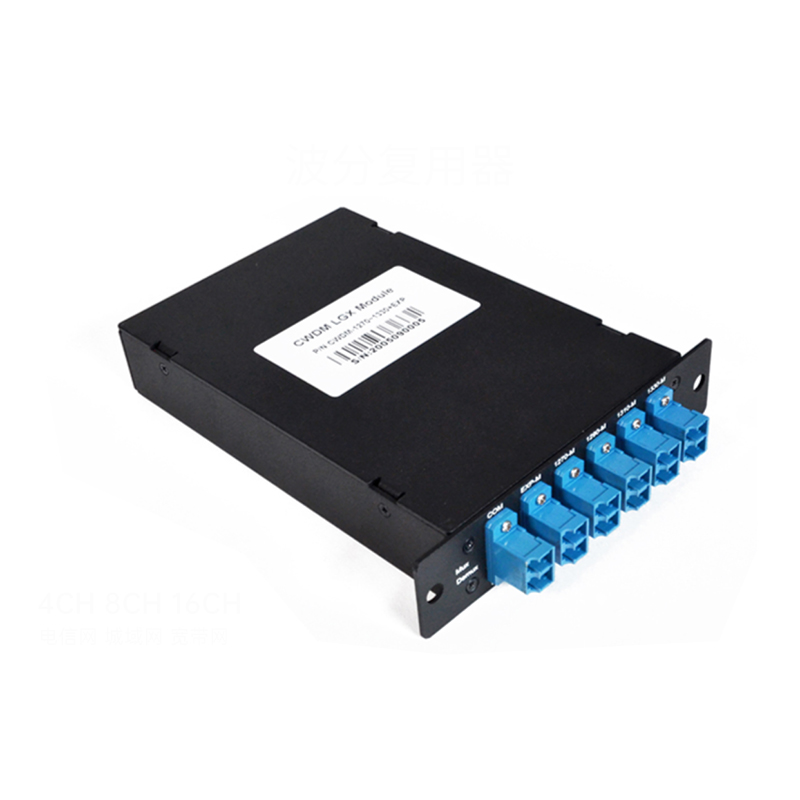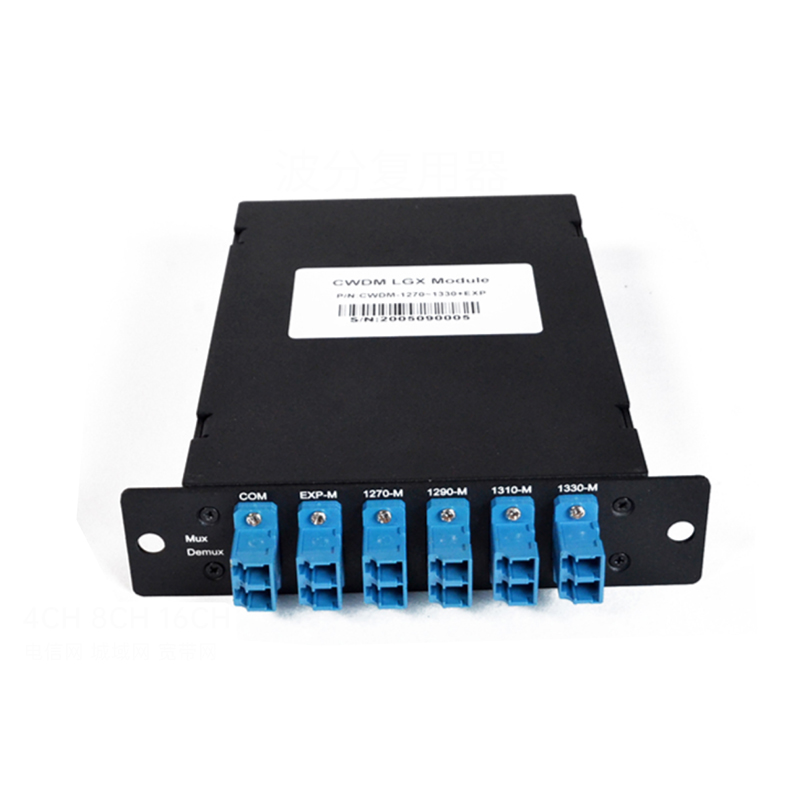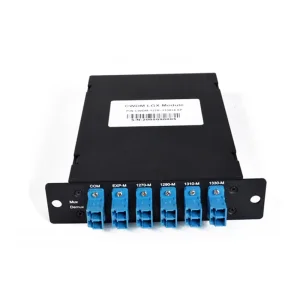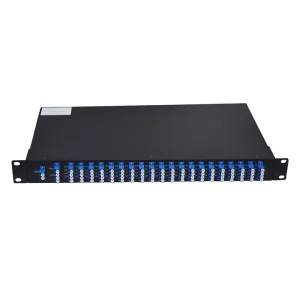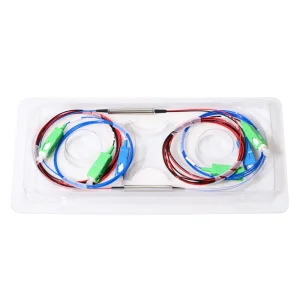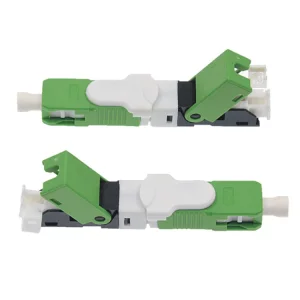
OEM Mux Demux 4 Channel Coarse Wavelength Division Multiplexing CWDM LGX box type LC/UPC Connector Supplier, Products

Channel number: 4CH, 8CH, 16CH, maximum 18CH. • Low Insertion Loss. • High Isolation.  Low PDL.  Compact Design. • Good channel-to-channel uniformity.

Product Description

⚙️
Channel Capacity
Channel number: 4CH, 8CH, 16CH, maximum 18CH.
📉
Optical Performance
Low Insertion Loss, High Isolation, Low PDL.
📐
Compact Design
Good channel-to-channel uniformity and a compact design suited for space-constrained layouts.
Key Advantages & Features
  • Small and light, Industrial design, can be placed flexibly.
  • Plug and play, easily install and maintenance, no need for configuration.
  • Zero transmission delay, improve transmission performance, support further distance.
  • Designed for passive fiber optic networks, no need for power, high reliability, support outdoor application.
  • Be transparent to any service signals, supporting FE/GE/10GE/25GE/100GE, OTU1/OTU2/OTU3, FC1/2/4/8/10, STM1/4/16/64, and others.
Understanding CWDM Technology
In fiber-optic communications, wavelength-division multiplexing (WDM) is a technology which multiplexes a number of optical carrier signals onto a single optical fiber by using different wavelengths (i.e., colors) of laser light. This technique enables bidirectional communications over a single strand of fiber, also called wavelength-division duplexing, as well as multiplication of capacity.
  • CWDM full name is Coarse Wavelength Division Multiplexing.
  • As the name states, it is a form of multiplexed fiber optics, so CWDM networks can send simultaneous, two-way communication.
  • The term “coarse” refers to the wavelength spacing between channels.
  • CWDM utilizes laser signals that differ in increments of 20 nm. A total of 18 different channels are available — with a wavelength range from 1610 nm to 1270 nm — and 8 can be utilized in a single system. Since each channel is capable of data rates of 3.125 Gbps, the aggregate ability is 10 Gbps for any CWDM cable.
  • CWDM is used for lower cost, lower capacity (sub-10G) and shorter distance applications where cost is an important factor.
  • CWDM is ideal for fast and long networks that don’t need more expensive speeds. It’s also ideal for a gradual upgrade of older systems.
  • CWDM can be your flexible line that keeps your options open, but you can still utilize other cable designs where the need arises.
Technical Specifications
Item Description Specification (4 Channel)
Insertion Loss (dB) ≤1.5
CWDM Central Wavelengths [λc] (nm) 1270-1610 or 1271-1611
Passband (@-0.5dB bandwidth) (nm) ±7.5
Isolation Adjacent Channel > 30
Non-Adjacent Channel > 45
Polarization Dependent Loss (dB) < 0.10
Polarization Mode Dispersion (ps) < 0.10
Return Loss (dB) > 45
Directivity (dB) > 50
Maximum Optical Power (mw) 500
Operating Temperature (°C) -20 ~ +75
Storage Temperature (°C) -40 ~ +85
Fiber Type Single mode G652D or G657A
Cable diameter 0.9mm, 2.0mm, customized
Pigtail length 0.3m, 0.5m, 1.0m, customized
Terminal connector LC/UPC, SC/UPC, customized
Label Customized
Package Customized
Parameter Value / Performance
Insert loss ≤ 0.2dB
Return loss 50dB (UPC) / 60dB (APC)
Durability 1000 Mating Cycles
Wavelength 850nm, 1310nm, 1550nm
Environmental Parameter Value
Operating temperature -25°C ~ +70°C
Storage temperature -25°C ~ +75°C
Relative humidity ≤85% (+30°C)
Air pressure 70Kpa ~ 106Kpa
Product Images
Additional Specifications & Applications
  • From 1260nm to 1620nm.
  • Wide Operating Temperature: -40°C to 85°C.
  • High Reliability and Stability.
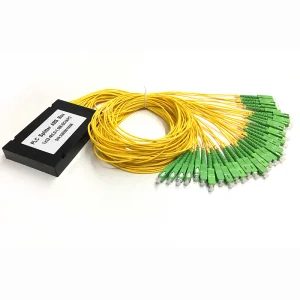
  • ABS module box.
  • Pigtail length: customized.
  • Terminal connector: customized.
🌐
Network Application 1
Passive Fiber Optic Networks, Metro/Access networks, WDM systems, and Fiber optical amplifiers.
📡
Network Application 2
CATV systems, 3G/4G/5G Mobile Fronthaul, and Data Center infrastructure.
Frequently Asked Questions (FAQ)

What is CWDM technology and how does it work?

CWDM (Coarse Wavelength Division Multiplexing) is a technology that multiplexes multiple optical carrier signals onto a single optical fiber by using different wavelengths (colors) of laser light, allowing for bidirectional communication and capacity expansion.

What is the channel spacing for CWDM systems?

CWDM utilizes laser signals that differ in spacing increments of 20 nm, covering a total range from 1270 nm to 1610 nm (or 1271 nm to 1611 nm).

Do passive CWDM networks require external power supplies?

No, passive fiber optic CWDM networks operate without any external power requirements, ensuring high reliability and suitability for outdoor deployments.

What kind of transmission delay can be expected with this device?

This system offers zero transmission delay, which improves overall transmission performance and supports longer signal propagation distances.

What services and signal rates are supported by this CWDM system?

It is transparent to any service signals, fully supporting FE/GE/10GE/25GE/100GE, OTU1/OTU2/OTU3, FC1/2/4/8/10, STM1/4/16/64, and other major transport protocols.

What options are customizable for this system?

Customization options are available for cable diameters, pigtail lengths, terminal connector types (such as LC/UPC, SC/UPC), labeling, and overall packaging configuration.
Related Products