Industrial Whitepaper: Navigating the 100G SR4 Architecture & Global Supply Chain
1. Overview of the Global Optical Interconnect Market & 100G SR4 Architecture
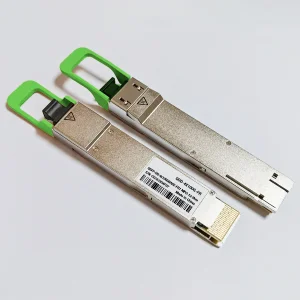
The relentless growth of global data traffic, catalyzed by Artificial Intelligence (AI), cloud-native computing, and hyper-scale infrastructure expansion, has shifted the baseline requirements for internal data center connections. In modern multi-tier networks, 100G SR4 transceivers (Short Range 4-channel) play a mission-critical role. Utilizing 4 independent lanes of parallel multi-mode optical transmission (each operating at 25 Gbps using NRZ modulation), 100G SR4 represents the workhorse optical interface for link distances up to 70m over OM3 or 100m over OM4 multi-mode fiber.
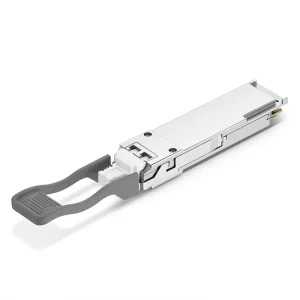
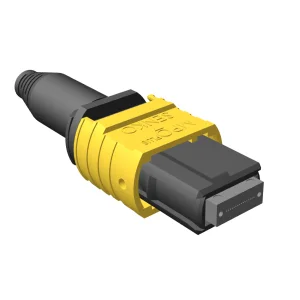
Engineered typically in the compact QSFP28 (Quad Small Form-factor Pluggable) form factor, the 100G SR4 transceiver employs VCSEL (Vertical-Cavity Surface-Emitting Laser) array technology emitting at a nominal wavelength of 850nm. By routing optical channels through a standard MPO/MTP connector interface, network operators secure cost-efficient, low-power, and highly dense cabling matrices.
100G
Standard bandwidth
13+
Years Industry Experience
100%
Tested and Inspected
24+
Global Carrier Tenders
2. Global Business and Industrial Scenarios for 100G SR4 Technologies
The commercial landscape for 100G SR4 spans diverse high-performance environments. Below are the key localized application scenarios that dictate global enterprise procurement strategies:
Hyperscale Data Centers
Enabling high-density switch-to-switch and switch-to-server interconnect architectures inside mega-clouds where short-reach multimode links dominate the internal fabric.
Edge Computing Nodes
Providing high bandwidth links at peripheral local exchange points, satisfying low-latency execution pipelines within smart manufacturing networks and telecommunication cell hubs.
High-Performance Clusters
Interconnecting distributed storage arrays, memory pools, and parallel processing CPUs/GPUs in AI computing environments to guarantee packet-loss-free execution.
Information Gain Insight: While 100G SR4 remains the standard short-reach multi-mode interconnect, advanced enterprises are transitioning to it as a flexible migration path to higher-density architectures. Its compatibility with existing multi-mode fiber base infrastructure avoids expensive single-mode fiber installations in intra-row configurations.
3. Industrial Efficiency: The Chinese Factory Manufacturing Advantage
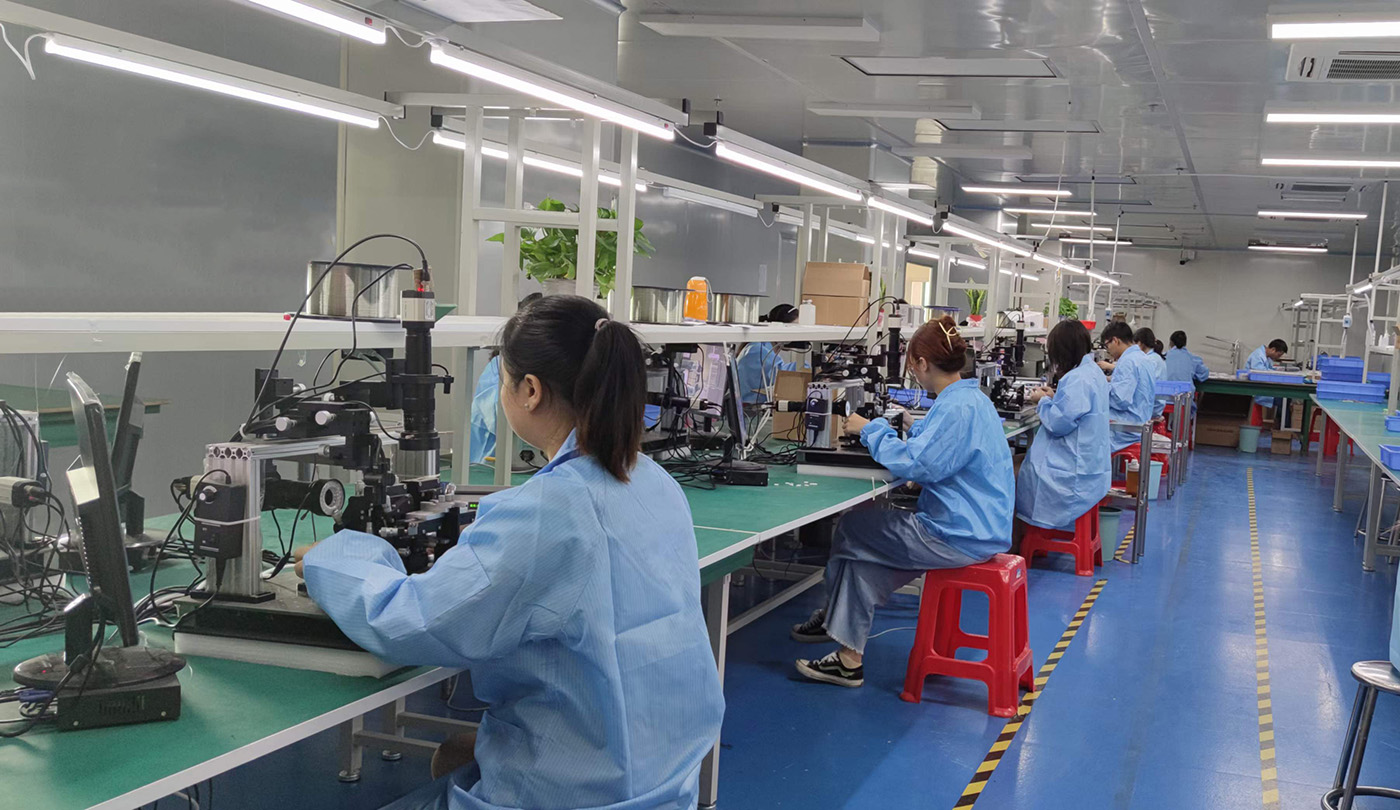
Global supply chain leaders prioritize manufacturers capable of providing robust volume scalability without compromising geometric precision and performance metrics. Kocent Optec Limited, based in Hong Kong and manufacturing across mainland China, typifies this dynamic.
Chinese manufacturing clusters leverage optimized regional economies of scale, extensive component supply chains (integrating local VCSEL lasers, high-grade photodetectors, and premium optical lenses), and highly automated sub-micron alignment tools. This synergy guarantees lower unit manufacturing costs compared to Western counterparts, while maintaining absolute compliance with global quality and physical design standards.
4. KOCENT OPTEC LIMITED: A Trusted Global Optical Partner
Established in 2012 in Hong Kong as a high-tech communication enterprise, Kocent Optec Limited has emerged as one of China's leading fiber optic termination product manufacturers and solution providers. We are dedicated to developing and manufacturing fiber optic communication products ranging from passive components to active modules tailored for enterprise networks, telecommunication carrier networks, and high-tier data centers.
With more than 13 years of technical experience in manufacturing telecommunication fiber optic products, we strictly adhere to rigorous global standards (such as Telcordia GR-326-CORE, IEC, and RoHS specifications). By utilizing mature scientific processes and automated production ecosystems, we deliver products on schedule and enforce a 100% test-and-inspection standard for all finished components before global transport.
Direct Operator Verification: Our commitment to reliability and cost-competitive engineering has enabled us to win major tenders from global telecom operators, satisfying end-user configurations for:
SingTel, Vodafone, America Movil, Telefonica, Bharti Airtel, Orange, Telenor, VimpelCom, TeliaSonera, Saudi Telecom, MTN, Viettel, Bitel, VNPT, Laos Telecom, MYTEL, Telkom, Telekom, Entel, FiberTel, StarFiber, Ooredoo, Beeline, and Azercell.
5. Crucial Global Enterprise Procurement Demands
In selecting high-quality 100G SR4 modules and passive components, enterprise buyers focus on the following key metrics to mitigate operational risk:
Multi-Source Agreement (MSA) Compliance: Devices must maintain compatibility with all major host platform brands (including Cisco, Juniper, Arista, and Huawei) without triggering system warning alerts.
Optical Alignment Precision: For MPO/MTP interfaces, low insertion loss (IL < 0.35dB) is critical to support complex path topologies and high connector counts on a single channel.
Thermal Tolerance Range: Commercial (0°C to 70°C) and industrial-grade (-40°C to 85°C) variations are selected based on whether deployment is inside climatized data center cores or in remote outdoor telecom enclosures.
6. Industry Q&A (FAQ) - Common Transceiver & Cabling Technical Inquiries
What is the connector configuration requirement for a standard 100G QSFP28 SR4 module?
100G QSFP28 SR4 modules operate over parallel multi-mode optical paths. They utilize a standard MPO/MTP female (no pins) connector configuration with 12 fibers. The module utilizes 8 outer fibers (4 transmit lanes, 4 receive lanes) and leaves the middle 4 fibers unused.
How does the transmission limit vary between OM3 and OM4 multi-mode fibers with SR4 transceivers?
According to the IEEE 802.3bm standard, a typical 100G QSFP28 SR4 transceiver supports transmission up to 70 meters on OM3 multi-mode fiber (which has an effective modal bandwidth of 2000 MHz·km at 850nm). When upgrading to OM4 multi-mode fiber (with 4700 MHz·km modal bandwidth), the transmission reach extends up to 100 meters.
What testing procedures are essential during factory production at Kocent Optec?
At our factory, every component undergoes strict testing protocols. For active modules, this includes bit error rate (BER) checks, eye diagram optimization, transmitter optical power measurements, receiver sensitivity sweeps, and environment chamber temperature cycling. For passive connector assemblies (like MPO-PLUS connectors), we measure insertion loss (IL), return loss (RL), and conduct 3D interferometry checks to verify optical end-face geometry parameters.
Is the 100G QSFP28 SR4 hot-swappable, and what are its dynamic power dissipation attributes?
Yes, the QSFP28 SR4 module is completely hot-swappable, allowing system insertion and removal without interrupting host equipment operations. Standard 100G SR4 transceivers exhibit low-power configurations, typically operating with a power consumption of less than 2.5 Watts, making them highly suitable for green data center deployments.


 KOCENT OPTEC